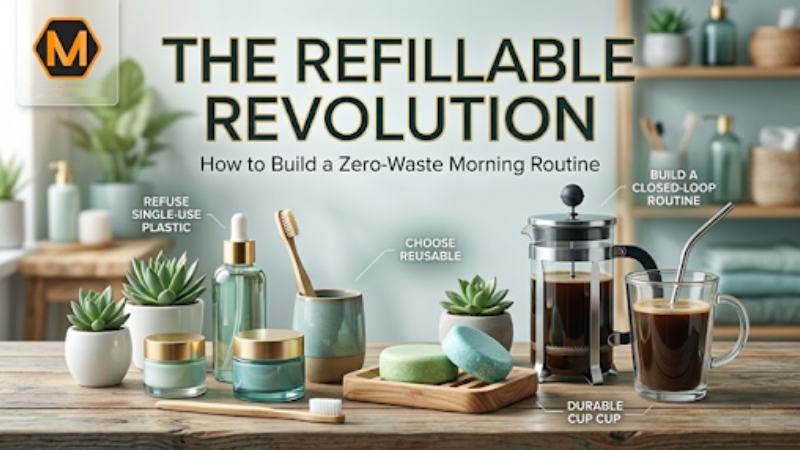
The Refillable Revolution: How to Build a Zero-Waste Morning Routine
The alarm rings, and the race begins. For many, the first thirty minutes of the day are a blur of plastic packaging, disposable wipes, and single-use coffee pods. While these conveniences feel like time-savers, they contribute to a massive global waste problem that is becoming impossible to ignore. The “Refillable Revolution” isn’t just about saving the planet; it’s about a fundamental shift in how we consume. By transitioning to a zero-waste morning routine, you aren’t just reducing your carbon footprint—you are simplifying your life and reclaiming your mental clarity before the workday even starts.
Embracing a sustainable lifestyle in 2026 requires looking at our habits through the lens of efficiency and longevity. We often clutter our bathrooms with half-empty plastic bottles, just as we clutter our schedules with tasks that drain our energy. High-performing individuals have realized that sustainability applies to both the environment and their personal bandwidth. To maintain a zero-waste schedule, many students and professionals find that utilizing assignment help via myassignmenthelp allows them to “refill” their mental reserves by delegating time-consuming research. Just as you would refill a glass soap dispenser to avoid plastic waste, delegating heavy documentation allows you to recycle your time into high-value activities that truly matter. This strategic offloading of “mental junk” is the cognitive equivalent of a zero-waste home.
Phase 1: The Plastic-Free Bathroom Audit
The bathroom is often the highest producer of waste in the modern home. From toothpaste tubes that take five hundred years to decompose to plastic-stemmed cotton swabs, the sheer volume of “hidden” plastic is staggering. To start your refillable revolution, you don’t need to throw everything away at once. Instead, perform a “bin audit.” Look at what you are throwing away most frequently and find a durable, refillable alternative for those items.
Switching to a compostable bamboo toothbrush is the easiest “quick win” for beginners. Next, consider the “waterless” movement. Traditional shampoos and body washes are up to 80% water, requiring large plastic bottles for transport. By switching to concentrated bars—shampoo, conditioner, and soap—you eliminate the need for plastic packaging entirely. Many brands now offer subscription services where you keep a high-end glass bottle and receive concentrated tablets in the mail. You simply add your own tap water, shake it up, and you have a premium product without the environmental guilt.
Phase 2: Refillable Skincare and the Ethics of Consumption
The beauty industry is a major contributor to the global plastic crisis, but the tide is turning. In 2026, “circular beauty” has become the gold standard. This means purchasing products in aluminum or glass containers that can be returned to the manufacturer or refilled at local “zero-waste” stations. These stations are popping up in major cities worldwide, allowing consumers to bring their own jars for everything from facial cleansers to high-end serums.
When you choose refillable skincare, you are often getting a higher quality product because the brand is investing in ingredients rather than flashy, disposable packaging. This mindful approach to consumption forces you to slow down. Instead of mindlessly applying layers of chemicals, you become aware of what you are putting on your skin and where those materials originated. This level of focus is a discipline that spills over into other areas of life. For instance, a student might be deeply immersed in a complex project, such as The Ultimate Character Analysis of Mark Antony in Julius Caesar, where the same attention to detail and “refining” process is required to peel back the layers of rhetoric and political motivation.
Phase 3: The Sustainable Breakfast Table
Once you leave the bathroom, the next hurdle is the kitchen. The average morning coffee routine is a minefield of waste, particularly with the prevalence of single-use pods. The refillable revolution encourages a return to classic, durable methods. A French press or a stainless steel pour-over filter eliminates the need for paper filters and plastic pods entirely.
Beyond coffee, look at your food storage. Plastic wrap and single-use sandwich bags can easily be replaced with beeswax wraps or silicone pouches. Buying in bulk is the ultimate refillable hack. By bringing your own cloth bags and glass jars to the grocery store, you can stock up on oats, nuts, and coffee beans without bringing home a single gram of plastic.
Comparison: The Morning Swap-List
| Item | The “Wasteful” Version | The Refillable Revolution Alternative | Impact Level |
| Coffee | Plastic Pods / Paper Filters | French Press / Stainless Steel Filter | High |
| Toothbrush | Plastic / Nylon | Bamboo / Replaceable Head | Medium |
| Shampoo | Liquid in Plastic Bottle | Solid Shampoo Bar / Refillable Glass | High |
| Toothpaste | Plastic Squeeze Tube | Toothpaste Tablets in Glass Jar | Medium |
| Food Storage | Plastic Wrap / Ziploc Bags | Beeswax Wraps / Silicone Pouches | High |
Phase 4: Mental Sustainability and Cognitive Load
A zero-waste morning routine is as much about your mind as it is about your trash can. In 2026, we are bombarded with “digital waste”—notifications, newsletters we don’t read, and social media feeds that offer zero value. This digital clutter creates a heavy “cognitive load” that makes us feel exhausted before we even start work.
To build a truly sustainable morning, implement a “No-Screen” first hour. Use this time to connect with your physical environment. Whether it’s tending to a small herb garden, meditating, or simply enjoying your coffee in silence, this boundary protects your mental energy. When you protect your focus, you work more efficiently, which reduces the time you spend on tasks later in the day. This “Mental Zero-Waste” philosophy ensures that you aren’t wasting your most valuable resource: your attention.
The Science of Micro-Habits in Sustainability
The reason many people fail at a zero-waste lifestyle is that they attempt a total overhaul overnight. Neuroscience suggests that sustainability is best achieved through “micro-habits.” Instead of trying to eliminate all plastic at once, focus on one “station” at a time. Start with the bathroom vanity. Once that becomes second nature, move to the shower, then the kitchen pantry.
When you master a micro-habit, your brain releases dopamine, making the next change easier. This psychological momentum is exactly how high-performers manage massive workloads. By breaking down a complex problem into smaller, manageable parts—much like breaking down a 5,000-word dissertation into semantic clusters—you prevent the “paralysis of choice” that often leads to inaction.
Building a Circular Economy at Home
The ultimate goal of the refillable revolution is to move away from the “Linear Economy” (Take-Make-Waste) and toward a “Circular Economy” (Reduce-Reuse-Recycle). In a circular home, every item has a lifecycle. Your organic kitchen waste becomes compost for your balcony garden. O old cotton t-shirts become cleaning rags. Your glass jars become bulk storage containers.
This cycle reduces the need for constant shopping and disposal, which in turn saves money and time. It creates a sense of “homeostasis”—a balanced state where your environment supports your goals rather than detracting from them. A clean, sustainable home office or study space is proven to lower cortisol levels, allowing for higher levels of creativity and problem-solving.
Scaling the Revolution: Beyond the Morning
The beauty of the refillable revolution is that once you start, you begin to see “waste” everywhere—not just in your home, but in your habits. Sustainable living is about building a system that can last a lifetime without causing burnout. If your morning is rushed and chaotic, your entire day will follow suit. By slowing down to refill your jars and brew your coffee intentionally, you are training your brain to prioritize quality over speed.
As this revolution grows, we will see more infrastructure supporting it. Local communities are already establishing “tool libraries” and “refill hubs” where resources are shared rather than bought and discarded. This shift toward a circular economy is the only way to ensure a livable planet for future generations. It requires us to move away from the “convenience at any cost” mindset and toward a “stewardship” mindset.
Summary: Small Changes, Global Impact
Building a zero-waste morning routine doesn’t happen overnight. It is a journey of intentionality that begins with a single choice: opting for the bar of soap instead of the plastic bottle, or the glass jar instead of the plastic bag. These small, daily actions compound over time, leading to a life that is lighter, cleaner, and more focused.
The refillable revolution is a call to return to a more intentional way of living. It invites us to be present in our daily rituals and to consider the lifecycle of everything we touch. By simplifying our physical environment and protecting our mental focus, we create space for what truly matters. Whether you are navigating a demanding career or a rigorous academic path, a sustainable foundation is the key to long-term success. Start your revolution tomorrow morning—one refill at a time.
Frequently Asked Questions
What is the “Waterless” movement in sustainability?
Most traditional liquid soaps and shampoos consist of up to 80% water. The waterless movement replaces these with concentrated bars or tablets. This reduces the weight for transport—lowering carbon emissions—and eliminates the need for plastic bottles entirely.
How does a zero-waste routine save money over time?
While some sustainable items have a higher upfront cost, they are designed for longevity. Refilling a high-quality glass bottle is significantly cheaper than repurchasing a new plastic one. Over a year, switching to durable alternatives like safety razors or solid bars can save hundreds of dollars.
What are the best materials for refillable containers?
Glass and aluminum are the gold standards. Unlike plastic, which degrades and absorbs chemicals over time, glass is infinitely recyclable and chemically inert. Aluminum is lightweight, durable, and has one of the highest recycling rates of any material in the world.
Can small morning changes really impact the global environment?
Yes. The average person uses thousands of pieces of single-use plastic in their lifetime. By making small shifts—like swapping a plastic toothbrush for bamboo—you prevent non-biodegradable waste from entering oceans. These collective individual actions drive the market demand for larger corporate and systemic changes.
About The Author
Ruby Walker is a seasoned academic strategist and lead content contributor at MyAssignmentHelp. With a focus on enhancing student productivity and mental clarity, she specializes in bridging the gap between high-level research and practical, human-centric learning strategies. For more details, Click here